autism and stimming

Autism and Depression, is there a link?

I have spent a lot of time with autism, and what I know for sure is that I don’t know autism. I mean, I know the stereotype, but ALL the kids that I have seen on the spectrum, are so uniquely different, that I can clearly say that nobody really “knows” autism. When I talk to teachers of “typical” kids, they always say that no two kids are alike in their class. Then why are people so quick to judge an autistic kid and drop them all in the same bucket? The fact is, you can’t.

What we do know about autism, is that we don’t know what causes it. But, we also know that it’s a “multi-faceted disease”, or some fancy term like that. In other words, there’s a LOT of different things converging at one time, which manifest themselves into “autistic behaviors”.

The fact is, we all have what I call “red flags”: challenges we face when we are a kid or even all throughout our adult lives. Typically we have 2 or 3 and the doctor tells our parents, “don’t worry, they’ll grow through it…” Whether this be dyslexia, hearing issues, bi-polar, ADHD, OCD, sensory, eating issues, etc., the list goes on and on. Our bodies, being amazing machinautism and depressiones at adaptation, adjust and find coping mechanisms that allow us to grow through or work with these red flags. Many of us use our own little quirks as a strength, once we understand and except our challenges (I’m clearly ADHD). But, autistic kids, they are just slightly different, they happen to have a few more “red flags”, and when their body can’t easily adapt to all these challenges, they combine to exhibit “autistic behaviors”.
What now becomes the new challenge is for the parents to find out what these “red flags” are and start working on them. It’s very hard at first, but once you start to identify and conquer these challenges, things start snowballing back together for your kid. This doesn’t just happen overnight, it takes years, but it can happen and may take ALOT of research, hard work, dedication, and deduction.

The really good news about finding these solutions for your child, is that, while you are “healing” one of these red flags, your child is adapting to their challenges on the inside, unbeknownst to you. It’s really cool, actually. As you fill their gap, they have built another strength, dare I say, a “super hero skill”. That’s the next trick, to find that newly created talent, AND FEED IT! Because they will be great….no, a genius in this area! And don’t think I’m the only one that thinks this is how a genius is created, listen to Barry Panter, a retired psychiatrist and psychoanalyst, when talking about people who are “wired” differently, “the neurosynaptic and neurochemical pathways in their brains may be different than most brains, and it may be this that contributes greatly to creativity and their genius” (quoted from USA Today article, “Tortured genius” by Maria Puente).

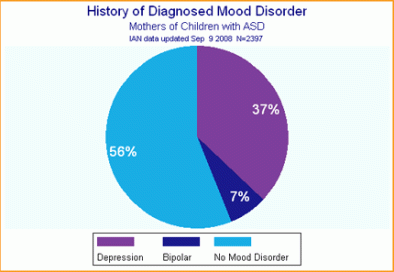
So, how is this all related to depression? Well, ever since Robin Williams passed away, I’ve been noodling this idea, because what I kept hearing from the “doctors” is that they don’t know exactly what causes depression and that it is typically manifested over years and due to several different causes….Several. Different. Causes. That’s it. That’s the connection.

At this point, this is more of an observation than anything else. But, there are two things I do know, many people on the autism spectrum are depressed and if you have one of these challenges, do something about it, because you don’t know what it will combine with down the road and manifest into. Most people who get help turn out stronger and better than before!

Code4Armour for Medical and Safety Issues

The Skinny: Code4Armour is a unique device that acts as a medical wristband. Essentially replacing your medical ID alert bracelet with a wristband that contains an RFID device. This allows any medical responder with an iPhone and an app access to all your child’s relevant medical information. I like this for some kids with challenges because if they have limited language, or neurological issues, or anything that can render their ability to communicate effectively, then this can be a perfect solution. They are currently funding on Indiegogo.  I have yet to try one out to see if it passes muster, because they are still in their funding phase, but it appears to be a fabulous device and can’t wait to get my hands on one to share my experiences with you. If you have a child that elopes this would be a great device as well, because it can help your child get back home when they are lost. Go over to their site and check them out.

What it is: Code4Armour

What it’s used for: Medical information for kids with language challenges.  Kids that elope frequently.

Ways to use it:

  • Medical:
      • You simply wear it on your wrist.  In case of an emergency, a medical responder scans the wristband and the information is pulled up.

    Where to find it: The products website is located here: Code4Armour.com

    Their Indiegogo site for crowdfunding this brand-new state-of-the-art product is here.

    The Source: Code4Armour. I connected with them through Twitter, and was really engaged with what this product can potentially do.

code4armour for medical

Code4Armour for Medical and Safety Issues was originally published on KidConnectionZ

Word Magic for Language, Spelling, and First Words

The Skinny: Word Magic is a great app that we used with my kid to help him learn his first words.  At about 3 years old, we were still very concerned about his language.  But, he was starting to come along.  I remember the time when we had a giant matrix of words, and worked every day…

Word Magic for Language, Spelling, and First Words was originally published on KidConnectionZ

Hyper Dash for Motor Planning and Sequencing

The Skinny: Hyper Dash is a fun, easy to set up game that can can be easy to play and progress to much more challenging.  In a nutshell, set up the different colored domes around your room, yard, house, etc, and then turn the hand held device on.  It will tell you a number or color, RUN…

Hyper Dash for Motor Planning and Sequencing was originally published on KidConnectionZ

Draw Write Now for Vision and Fine Motor Planning

The Skinny: Draw Write Now is a drawing book… but really, it’s a lot more than that…they are educational books, where you don’t realize you are learning!  If you have a kid who happens to be hyper-focused on one subject, this can be a nice gateway to expand that focus. It is a tool that our…

Draw Write Now for Vision and Fine Motor Planning was originally published on KidConnectionZ

autism and stimming

Stimming on Stimming

As a parent of a kid with challenges the word “stimming” is like a dagger in the heart.  I’m going to take the gloves off and tell you if you are working with a “professional” (yes, I purposely put that word in quotes, because sometimes you just wonder where they actually got that degree from) and they use the word “stimming” then get a new professional. Because they clearly don’t know what is driving child to do what they are doing. I am not joking here, although the irony of the title of this article doesn’t escape me.  It seems that if some therapists don’t know what’s driving a kid to do what they do, then they drop this word like it’s no issue, it’s almost as if they are stimming on the word “stimming” itself.

If your therapist even mentions the word “stimming” to you, the parent, or even the more politically correct version, “perseverate”, lose them!  They clearly don’t know how to work through and manage your kid’s challenges. Using those words are just a cop out for not knowing what to do!  I know it is easy for me to sit here on a keyboard and say “just drop your therapist”.  But, in reality, you should really start looking for one more appropriate for your child’s needs.

I learned this recently from working with a speech therapist, when my kid kept talking about a certain subject.  I was getting frustrated and clearly lost.  She brought up the word to teach me on how and we should not use it.  Then I watched her simply sit back, watch my kid for a short while, then go in and start talking with him.  What was amazing, is she just dove into what he was talking about, and started expanding in several different ways around the subject, until he stopped talking about it.  Essentially, he has this itch to learn more about this word or subject, but didn’t quite know how to ask that or explain what he was thinking.  She taught us a new way to approach it and all this “stimming” went away after a few months.  She hit it right on the head, and it was her wisdom that knew what to look for.  I am so grateful to work with her and, more importantly, to have her constantly educate us on the “why”, so we know what to do in the future.

Learn more ways to work with your child on their challenges at: KidConnectionZ.com

Shakespeare Plays Designed for Autistic Kids

This is something that touches my heart deeply, but poses a bigger question, why don’t live theater and movie theaters do performances and shows for kids with sensory challenges more often? First of all, this post is inspired by Kelly Hunter from the Royal Shakespeare Company, in conjunction with the Ohio State University. A big shout out goes…

Shakespeare Plays Designed for Autistic Kids was originally published on Shakespeare for Kids Books