#ShakesTag the Online Game of Shakespeare

Well today is the day of the week that most people practice religion of one type or another. For some people it’s the church, others football, and to others, reading is religion. Stepping into a slightly tighter niche than that, Shakespeare. And some of these people who love the Bard, get together on Sunday for a friendly game of #ShakesTag.#ShakesTag

What is #ShakesTag, you may ask? Well, it’s a game created by two ladies: Dr. Wells and Lara Schiffbauer. But every week they play to some type of theme, post together a short Shakespeare tweet, related to said theme, then tag it with #ShakesTag. And off goes the game!

It’s surprising, how many people are playing, and it’s fun to get tagged by someone, because it means you’re “in the gang”.

But teachers, this is where I think you can engage your kids in learning some of Shakespeare’s famous lines with your class. Or, more importantly, that is language means more than just words written on a piece of paper. During one of your classroom sessions, start a #ShakesTag game with your kids on Twitter. See how many references to “love” or insults, or humor, or some other term that would surprise and engage your kids.

Let me know how it goes. And if you have any stories of teaching kids with Shakespeare, I would love to hear and share them. Let me know!

-brendan

#shakestag rules

#ShakesTag the Online Game of Shakespeare was originally published on Shakespeare for Kids Books

Shakespeare Plays Designed for Autistic Kids

This is something that touches my heart deeply, but poses a bigger question, why don’t live theater and movie theaters do performances and shows for kids with sensory challenges more often? First of all, this post is inspired by Kelly Hunter from the Royal Shakespeare Company, in conjunction with the Ohio State University. A big shout out goes…

Shakespeare Plays Designed for Autistic Kids was originally published on Shakespeare for Kids Books

Celebrity Impersonations of Hamlet’s To be or not to be Speech

I recently came across a great video through Twitter that is pretty impressive.  Jim Meskimen is a professional impersonator and he spun together a great 2 minute video that’s both engaging and original.  He was able to perform the famous, To be or not to be monologue from Hamlet with about 25 different famous celebrity impersonations.  You can follow Jim on Twitter at: @jimrossmeskimen

You can see the video here:

YouTube Preview Image

And Jim has another Shakespeare from celebrity impersonations below.  This one has been seen almost 1 million times!  Not too shabby!

YouTube Preview Image

Celebrity Impersonations of Hamlet’s To be or not to be Speech was originally published on Shakespeare for Kids Books

13 Words first penned by Shakespeare

As we all know, Shakespeare wrote a lot of words.  Many of which he made up on the fly, or simply was the first one to actually write them done.  Regardless, he alone added somewhere upwards of 5,000+ words and phrases to the English language.  Some of these, we use every day.  Here’s a list of 13 words first penned by Shakespeare:
13 words penned by Shakespeare

Gloomy

Quote: “Forced in the ruthless, vast, and gloomy woods?” – Titus Andronicus

Laughable

Quote: “Though Nestor swear the jest be laughable.” – The Merchant of Venice

Majestic

Quote: “This is a most majestic vision” – The Tempest

Lonely

Quote: “Believe’t not lightly – though I go alone / Like to a lonely dragon that his fen -Coriolanus

Radiance

Quote: “For by the sacred radiance of the sun” – King Lear

Hurry

Quote: “Lives, honors, lands, and all hurry to loss.” – Henry VI Part 1

Generous

Quote: “Free me so far in your most generous thoughts / That I have shot mine arrow o’er the house / And hurt my brother.” – Hamlet

Frugal

Quote: “Chid I for that at frugal Nature’s frame?” – Much Ado About Nothing

Critical

Quote: “For I am nothing if not critical” – Othello

Courtship

Quote: “To courtship and such fair ostents of love” – The Merchant of Venice

Zany

Quote: “Some carry-tale, some please-man, some slight zany” – Love’s Labour’s Lost

Undress

Quote: “Madam, undress you and come now to bed.” – The Taming of the Shrew

Rant

Quote:”I’ll rant as well as thou.” – Hamlet


13 Words first penned by Shakespeare was originally published on Shakespeare for Kids Books

Hilarious Macbeth Summary Video

I tripped over this Macbeth summary video on YouTube, it’s pretty funny, and if you have high-schoolers, it’s a perfect quick summary that’ll fit right into their teenage attitude!  Enjoy!


YouTube Preview Image

Hilarious Macbeth Summary Video was originally published on Shakespeare for Kids Books

How Many Plays did Shakespeare Write?

Well, this has been an age-old question, asked throughout the years.  But, no one will ever truly know the exact answer to how many plays did Shakespeare write, because there is always the following arguments:

  • He plagiarized and never really did “write” the plays
  • There are “lost” plays: i.e. “Love’s Labour’s Won”, Cardenio
  • He co-wrote some plays with other authors: i.e. Two Noble Kinsmen
  • Other plays that “experts” are considering written, or re-written by Shakespeare but not originally attributed to the Bard

But, for a number to answer the basic question of how many plays did Shakespeare write? For now, it’s 37. (and you’ll find plenty of arguments for and against this!).  I’ve listed them below, with a link to my melodramatic kids’ versions as well.

Comedies (17):

  1. 37 shakespeare playsA Midsummer Night’s Dream
  2. All’s Well That Ends Well
  3. As You Like It
  4. Cymbeline
  5. Love’s Labour’s Lost
  6. Measure for Measure
  7. Much Ado About Nothing
  8. Pericles
  9. The Comedy of Errors
  10. The Merchant of Venice
  11. The Merry Wives of Windsor
  12. The Taming of the Shrew
  13. The Tempest
  14. The Two Gentlemen of Verona
  15. The Winter’s Tale
  16. Troilus and Cressida
  17. Twelfth Night

Tragedies (10):

  1. Antony and Cleopatra
  2. Coriolanus
  3. Hamlet
  4. Julius Caesar
  5. King Lear
  6. Macbeth
  7. Othello
  8. Romeo and Juliet
  9. Timon of Athens
  10. Titus Andronicus

Histories (10):

  1. Henry IV, Part 1
  2. Henry IV, Part 2
  3. Henry V
  4. Henry VI, Part 1
  5. Henry VI, Part 2
  6. Henry VI, Part 3
  7. Henry VIII
  8. King John
  9. Richard II
  10. Richard III

How Many Plays did Shakespeare Write? was originally published on Shakespeare for Kids Books

Insult Like Shakespeare Day – April 23rd

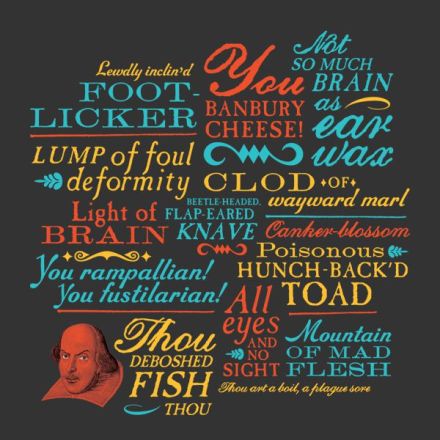
Classic Shakespeare InsultsOk, I’m making a bold statement.  Nay, I’m doing what must be done, and I need YOUR help to spread the word!  As you know, I write short, humorous, melodramatic renditions of Shakespeare’s plays, all in an effort to make The Bard easy for children (and adults!) to understand.  Well, since I’m on this mission to make Shakespeare fun and exciting for kids (like Disney says, “kids of all ages”) and, in acknowledgment to The Bard’s birthday, this April 23rd I’m declaring the first annual, “Insult Like Shakespeare Day!”  (go straight to the insult generator here) I’m truly surprised no one has done this before, but, think about it, what better way to engage in The Bards many innuendos, than by embracing what he truly does better than the rest of us, insults!  Let’s review, he came up with these classics:

  • “I desire that we be better strangers.” from As You Like It
  • “Tempt not too much the hatred of my spirit, for I am sick when I do look on thee.” from A Midsummer Night’s Dream
  • “I do wish thou were a dog, that I might love thee something.” from Timon of Athens
  • “If you spend word for word with me, I shall make your wit bankrupt.” from Two Gentlemen of Verona
  • “You have such a February face, so full of frost, of storm and cloudiness.” from Much Ado About Nothing
  • “I’ll beat thee, but I should infect my hands.” from Timon of Athens
  • “Not so much brain as ear wax.” from Troilus & Cressida
  • “Thou art a base, proud, shallow, beggarly, three-suited, hundred-pound, filthy worsted-stocking knave; a lily-liver’d, action-taking, whoreson, glass-gazing, superserviceable, finical rogue; one-trunk-inheriting slave; one that wouldst be a bawd in way of good service, and art nothing but the composition of a knave, beggar, coward, pandar, and the son and heir of a mungril bitch.” from King Lear

WOW, on that last one, right?  That was a bleeping, mouthful!  So, in the spirit of all that is insulting, I am declaring Shakespeare’s birthday to be the official first annual Insult Like Shakespeare Day!  I mean, we could talk like Shakespeare, but really, that’s just talking like EVERYONE else from that era, nothing special to Shakespeare.  But, insults, who doesn’t like a nice, quick-witted, stinging, insult from time to time, right?!  And THAT would be really honoring The Bard at his best!  So, don’t be a (here they come…)

  • Artless, tickle-brained, flap-dragon, or a
  • Mewling, fool-born, bugbear, or a
  • Paunchy, elf-skinned, ratsbane, or a

Well, I could go on, and on, with this list!  But, IT’S EASY to create your own.  Just open my insult generator and print out your very own insult generator sheet and get started ripping on your co-worker, or greeting your significant other in the morning with one of these beauties, or, as I have always said, insult your English teacher with this list and you will IMPROVE  your grade!

So, I need your help to the spread the word about the official Insult Like Shakespeare Day, April 23rd.  Please share the love with all you know, and be sure to do it with a juicy insult and a smile!  You can copy this link and paste it to make it easy:

April 23rd is Insult Like Shakespeare Day! Find your insult here and share the love, you rank, elf-skinned, lout! http://ow.ly/vUSKL

(quick thanks to bachelorsDegree.org for providing the list of Shakespeare’s insults bulleted above)

Insult Like Shakespeare Day – April 23rd was originally published on Shakespeare for Kids Books
Behind Barbed Wire, Shakespeare Inspires Syrian Kids

At the Zaatari Refugee Camp in Jordan, thousands of Syrians are seeking refuge from a country torn down by civil war.  They are living in tents, some nights freezing, and in search of just basic needs such as water and food.  In an effort to bring enlightenment and laughter back into their lives, many of these Syrians are kids have decided to perform Shakespeare’s King Lear.  With no stage or costumes, these Syrian kids really know how to use their imagination.  A truly inspiring article by the NY Times Ben Hubbard and an amazing show of how Shakespeare is still touching lives all around the planet, even behind barbed wires during an oppressed time.   Thank you Ben, for opening our eyes to where Shakespeare has reached.

You can read the full article here.

desert

Syrian Kids with Shakespeare in the desert


Behind Barbed Wire, Shakespeare Inspires Syrian Kids was originally published on Shakespeare for Kids Books

Can Shakespeare get you to Disneyland?

Okay, I will be the first to tell you that I am a big Disneyland fan. Now, to hear that there is an opportunity for doing some theater, dare I say SHAKESPEARE, and that’ll get me in the gate at Disneyland on the cheap, I am all about that! This a great article about a school that is trying to do just that.

I really want to root them on, because anytime you can get Shakespeare and Disneyland tied into one joint effort, that makes it all the more worthwhile.

Below is the story about their journey:

http://m.gazette.com/local-theater-students-will-compete-at-disney-world/article/1515215

Can Shakespeare get you to Disneyland? was originally published on Shakespeare for Kids Books

Imitation: Shakespeare is the King of Compliments

We’ve all heard the saying by Charles Caleb Colton: Imitation is the sincerest form of flattery. If that’s the case, then Shakespeare is the king of compliments. His plays have lived on for over 400 years, but most of the ideas, story lines and characters were not his own, they were imitations of others:

  • Romeo and Juliet was an Italian folk tale, passed down through generations until it was put into a poem form by Arthur Brooks. Shakespeare played down the morality a bit, and upped the romance, and boom, created a winner.
  • Hamlet was originally a Scandinavian legend. Around 1589, years before Shakespeare wrote the play we know today, there was a different Hamlet being performed on the English stage. The theater going public were well acquainted with the character of Hamlet before Shakespeare presented his own version.
  • Julius Caesar was a well know historical figure, of course, but academia agrees that Shakespeare based his play on Plutarch’s Lives of Noble Grecians and Romans.


The list goes on and on, and although not many of Shakespeare’s stories were original, his ability to craft lines that resonate deeply with people’s humanness – be it love, despair, hope, revenge or fear—is what has kept him at the top of the list of respected playwrights for generations.

So, why is this important? In today’s world we stress originality; kids are taught to be inventive, to think outside of the box, to do something different. Sometimes, however, we can be creative (brilliant, even) by taking ideas that already exist and putting our own spin on it (imitation). Good stories live on and on, and are recycled over and over again. Encourage your kids to take a story they enjoy and mix it up! Put it in play form or rewrite it from a different character’s perspective. Make it into a song or an interpretive dance.

Urge your kids to be more like Shakespeare: take a good idea and run with it.  Heck, Disney did imitation… who can tell me what play The Lion King was based off of?

Thanks for the stories, Shakespeare!


Imitation: Shakespeare is the King of Compliments was originally published on Shakespeare for Kids Books